Solder Paste Guide: Type, Alloy, Storage, Printing, and Reflow Control
Solder paste is not just powdered alloy in flux. Its alloy, particle size, metal load, storage control, stencil behavior, and reflow profile decide whether SMT assembly runs cleanly or fills the defect log with opens, bridges, voids, and head-in-pillow failures.
For more information on industry standards, see printed circuit board and IPC standards.
If solder paste sits warm on the production floor for 6 to 8 hours before print qualification, I assume the process window has already narrowed. Paste chemistry is consumed long before the defect report tells you that yield is drifting.
— Hommer Zhao, Technical Director
Solder paste is one of the most sensitive variables in SMT PCB assembly. Teams often talk about it as though it were a consumable that can be swapped freely as long as the alloy matches the assembly temperature. In reality, solder paste selection controls print definition, tack life, slump resistance, voiding behavior, wetting speed, residue profile, and the margin you still have when stencil apertures, pad geometry, humidity, or reflow conditions are less than ideal.
That matters because most SMT defects are not mysterious. They usually begin upstream in paste handling, stencil release, or thermal profiling. If you already know the board will use fine-pitch QFN, bottom-terminated parts, large thermal pads, or mixed-technology assembly, the solder paste decision should be reviewed together with PCB stencil service, through-hole PCB assembly, and our DFM design rules reference before the first build is released.
For standards context, solder paste, surface-mount technology, and reflow soldering are useful public references. The real manufacturing question is simpler: which paste gives your board enough process margin to print cleanly, survive the line environment, and reflow without avoidable defects?
What Solder Paste Actually Does
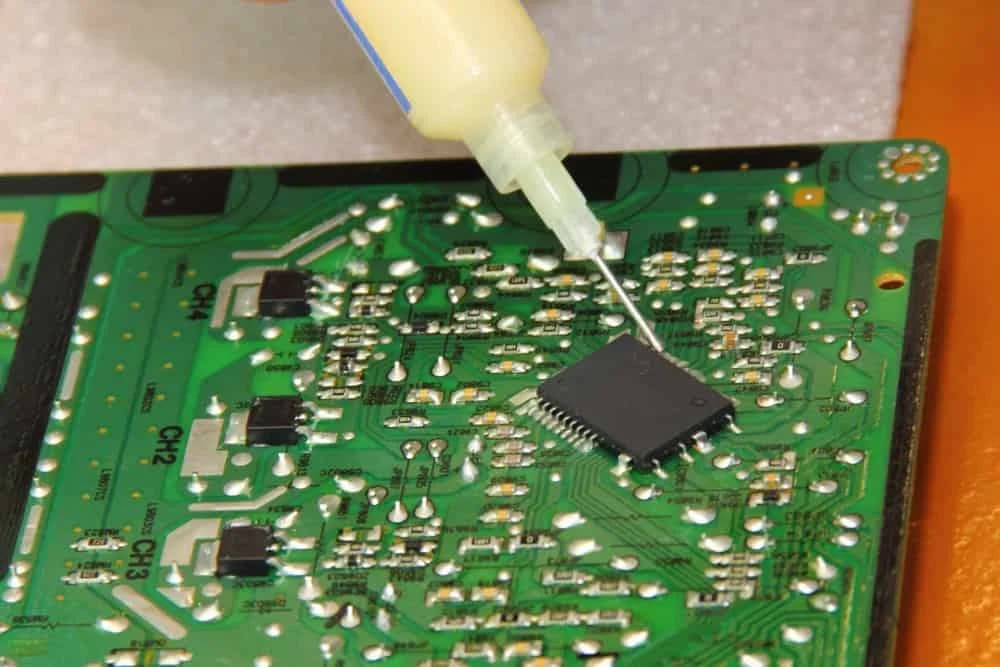
Solder paste is a suspension of microscopic solder alloy spheres in a flux medium. The alloy becomes the final electrical and mechanical joint after reflow. The flux removes oxides, protects the metal surfaces during heating, improves wetting, and helps the paste print and hold shape before the oven.
That means solder paste has to do five jobs well:
- Release from the stencil aperture consistently.
- Stay where it is printed without slumping into adjacent pads.
- Hold the component accurately with enough tack before reflow.
- Wet the pad and termination fast enough during the thermal cycle.
- Leave an acceptable residue and defect level after soldering.
If any one of those steps becomes unstable, the same paste that looked acceptable on a coupon board can create bridges on 0.4 mm pitch devices, opens on small passives, voiding under thermal pads, or skewed parts after placement. That is why paste is both a material choice and a process-control tool.
How To Choose the Right Solder Paste
Start with the assembly, not the paste datasheet. The right solder paste depends on component pitch, stencil thickness, aperture design, board finish, atmosphere, cleanliness requirements, and thermal mass.
| Paste variable | What it changes on the line | Best fit | Main risk if chosen badly | Typical control point |
|---|---|---|---|---|
| Alloy system | Melting range, joint reliability, thermal stress | SAC305 for mainstream lead-free, Sn63/Pb37 for legacy leaded repair or controlled exemptions | Wrong peak temperature or weak wetting margin | Profile validation and customer compliance review |
| Powder type | Aperture release and fine-feature printability | Type 4 for mainstream SMT, Type 5 for very fine pitch and micro apertures | Poor release or excess oxidation cost | Smallest aperture area ratio |
| Metal load | Print volume, slump behavior, transfer repeatability | Matched to stencil thickness and printer setup | Bridges, insufficient deposit, unstable print height | SPI height and area measurement |
| Flux chemistry | Wetting, residue, cleaning need, tack life | No-clean for many builds, water-soluble when post-cleanliness is mandatory | Residue failure, corrosion risk, weak shelf life discipline | SIR/cleanliness requirement and cleaning process |
| Tack and open time | Placement stability across line delay | Long placement windows and mixed-density boards | Parts shift after placement or dried paste before reflow | Time-out-to-discard rule |
| Void performance | Thermal-pad and BTC yield | Power devices, QFN, LED, RF shields | Heat transfer loss and X-ray rejects | X-ray voiding acceptance limit |
The table is the practical view. Buyers ask, "Which paste do you use?" The manufacturing answer should be, "Which board features and process risks are you trying to control?"
Alloy Selection: SAC305 Is Common, Not Universal
Lead-free SMT assembly commonly uses SAC305, a tin-silver-copper alloy with a melting point around 217°C. It is popular because it balances wetting, mechanical reliability, and supply stability across many commercial assemblies. That does not make it universal.
Some products still run leaded alloys for approved legacy programs, while others use low-silver or specialty alloys to reduce cost, improve drop performance, or manage thermal sensitivity. The alloy cannot be selected in isolation from the board and component temperature limits. If your assembly includes temperature-sensitive connectors, LEDs, plastic housings, large copper pours, or mixed thermal mass, the profile margin may matter more than the nominal alloy choice.
The common mistake is assuming a higher peak temperature will rescue a weak paste or bad print. It often does the opposite by damaging flux activity early, increasing oxidation, and worsening voiding or component stress.
On most lead-free builds, I would rather fix aperture design and soak behavior than keep pushing peak temperature upward. Once your peak is 245°C to 250°C with a weak print, you are usually hiding the real problem instead of solving it.
— Hommer Zhao, Technical Director
Powder Type and Fine-Pitch Printing
Powder size is usually labeled by type. In general, smaller particles support finer aperture release, which matters for 0.5 mm pitch and below, micro-BGA work, and dense bottom-terminated devices. Type 3 paste is still seen on older or coarser geometries, but many modern SMT lines treat Type 4 as the practical baseline. Type 5 is often chosen when aperture dimensions become small enough that release efficiency starts collapsing.
Smaller powder is not a free upgrade. It raises cost, can oxidize more easily if handling is poor, and may be unnecessary on robust apertures where a well-controlled Type 4 process already prints cleanly. The right choice comes from the smallest real aperture, stencil thickness, and required transfer efficiency, not from marketing language about "ultra-fine" performance.
If the board includes fine-pitch packages and large thermal pads on the same side, paste selection has to be reviewed with stencil strategy. A paste that releases beautifully on tiny apertures can still behave poorly if the stencil thickness or aperture reduction is wrong.
Storage, Conditioning, and Shelf-Life Control
A solder paste label is not enough quality control. Storage temperature, thaw time, mixing method, and exposure time on the line all affect print behavior.
Most refrigerated pastes need controlled warm-up to room temperature before opening, often around 2 to 4 hours depending on jar or cartridge size. Opening cold paste invites moisture condensation, which can destabilize print response and reflow behavior. Over-mixing is also a real problem because aggressive handling changes rheology and can reduce tack.
In production, the practical controls usually include:
- Refrigerated storage with logged lot and expiration date.
- Defined warm-up time before opening.
- Controlled remixing method and duration.
- Maximum time at room temperature before discard or retest.
- Lot traceability into the stencil-printing record.
- Separation of fresh paste from paste returned from the stencil.
Those controls are not bureaucracy. They are how you prevent a line from using chemically tired paste because the jar still appears half full.
Printing Performance: Where Most Paste Problems Begin
Most solder defects begin at print, not in the oven. If the deposit volume is wrong, reflow only exposes the mistake.
Stencil thickness, aperture shape, squeegee pressure, print speed, snap-off behavior, understencil cleaning frequency, and board support all interact with the paste. This is why paste qualification should include solder paste inspection, not only final AOI. A deposit that is 20% low on a QFN center pad or one side of a 0201 array may still place normally and fail only after reflow.
For example, large thermal pads usually need window-pane aperture designs to control voiding and solder float. Fine-pitch gull-wing parts may need aperture reductions to control bridging. Small passives near uneven copper balance can be vulnerable to tombstoning if paste volume is not symmetrical enough. The paste must support those stencil decisions rather than fight them.
A good print process watches repeatability across the full panel, not just the first board. If pad deposits start drifting after 5 to 10 prints, the issue may be paste open time, stencil contamination, or room-condition variation rather than the nominal printer setting.
Reflow Behavior, Voiding, and Defect Control
After printing and placement, the paste still has to survive the reflow profile. Flux activation, solvent evaporation, oxide removal, alloy coalescence, and residue formation all happen across a narrow thermal window.
Common defect patterns tied to paste and profile interaction include:
- Bridging from excess volume, slump, or poor soak control.
- Head-in-pillow on BGAs when oxidation and warpage margins are weak.
- Voiding under QFN pads, BTC devices, and LED thermal pads.
- Tombstoning on small passives from unbalanced wetting forces.
- Grainy or disturbed joints when profile or alloy fit is poor.
- Solder balls from paste handling, humidity, or stencil-release issues.
Void control deserves special attention. Not every void is a reject, but power electronics, LED boards, and bottom-terminated components often have real thermal or RF consequences when the void ratio becomes excessive. That is why low-volume PCB manufacturing and pilot builds should verify X-ray acceptance early instead of discovering late that the chosen paste and aperture pattern cannot hold the required limit.
If the product depends on a large exposed pad for heat removal, I want voiding reviewed on the first article, not after the design is already released for 500 units. On power devices, a 10% process change can move junction temperature by several degrees Celsius.
— Hommer Zhao, Technical Director
No-Clean vs Water-Soluble Flux Systems
No-clean paste is common because it simplifies production and usually leaves benign residue when the process is well controlled. Water-soluble systems can deliver strong activity and clean surfaces, but they demand a validated wash process and tight timing discipline after reflow.
The decision depends on the product. High-impedance analog assemblies, some RF boards, conformal-coating plans, and cleanliness-sensitive electronics may justify stronger post-clean control. Many commercial SMT boards do not need that complexity if the no-clean residue is compatible with the electrical and cosmetic requirements.
The mistake is selecting water-soluble paste because it sounds “cleaner” while underestimating the cleaning validation burden. The opposite mistake is using no-clean paste on a board that will later fail residue compatibility checks around coating, test probes, or high-impedance leakage paths.
A Practical Qualification Checklist
Before freezing a solder paste for production, verify these items on real hardware:
- Stencil release is stable on the smallest and most difficult apertures.
- SPI confirms repeatable deposit height, area, and volume across multiple prints.
- Placement tack remains acceptable through the expected line dwell time.
- Reflow profile stays inside component and alloy limits with measured thermocouples.
- AOI and X-ray results meet acceptance on fine-pitch and thermal-pad features.
- Residue behavior is acceptable for cleanliness, coating, ICT, and field reliability needs.
- Paste lot, thaw, open time, and discard rules are documented in the traveler or work instruction.
That checklist costs less than debugging an unstable line after launch.
FAQ
Q: What solder paste type is best for fine-pitch SMT assembly?
For many modern SMT builds, Type 4 is the practical baseline, while Type 5 is often considered for very fine apertures such as 0.4 mm pitch and below. The real decision depends on aperture size, stencil thickness, and transfer-efficiency targets, not just the package pitch alone.
Q: How long can solder paste stay at room temperature before printing?
The exact limit depends on the manufacturer, but many production controls treat 4 to 8 hours as a critical review window and require discard or retest beyond the documented exposure rule. What matters is following the paste data sheet and recording the actual open-time history by lot.
Q: Is SAC305 always the right alloy for lead-free PCB assembly?
No. SAC305 is common because its 217°C melting point and broad availability fit many assemblies, but specialty alloys may be better for low-temperature parts, drop-shock priorities, or cost-sensitive programs. The alloy must match both compliance requirements and the validated reflow window.
Q: Why does solder paste cause voiding under QFN or LED thermal pads?
Voiding is usually driven by flux outgassing, aperture pattern, pad design, and reflow behavior rather than by one variable alone. Window-pane stencil designs, controlled soak zones, and X-ray verification are standard ways to reduce void ratios when the product has thermal or RF sensitivity.
Q: Do I need water-soluble paste instead of no-clean paste?
Only when the product's cleanliness requirement justifies the extra process. Water-soluble systems can perform well, but they require a validated wash process, fast post-reflow cleaning, and residue control. Many commercial assemblies meet IPC-style workmanship goals with a qualified no-clean process instead.
Q: What should I review first if solder bridges or opens appear after reflow?
Start with stencil deposits, not the oven alone. In many cases the first checks should be SPI data, aperture geometry, stencil thickness, print parameters, and paste age. Reflow changes the symptom, but the root cause often began at print 1 rather than zone 7.
If your next build includes fine-pitch ICs, QFN thermal pads, mixed-technology assembly, or tight cleanliness requirements, contact YourPCB before release. We can review the solder paste, stencil plan, and reflow strategy together so the first article reflects the real production process instead of a best-case lab setup.


Need Help with Your PCB Design?
Check out our free calculators and tools for electronics engineers.
Browse PCB Tools"In over 20 years of manufacturing experience, we have learned that quality control at the component level determines 80% of field reliability. Every specification decision you make today affects warranty costs three years from now."
— Hommer Zhao, Founder & CEO, WIRINGO