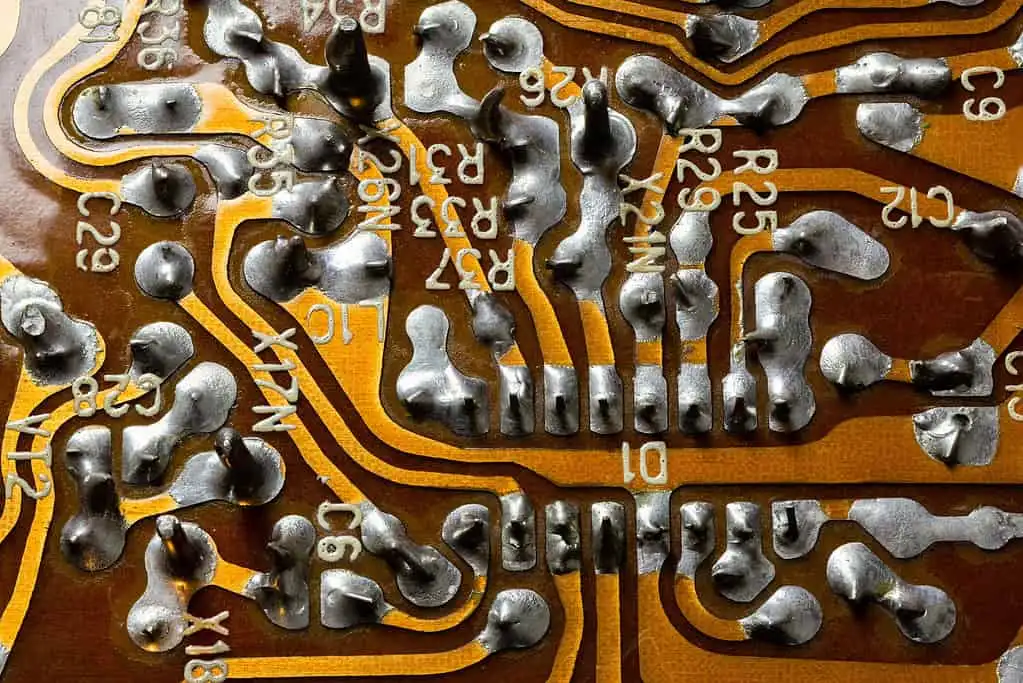
Choosing the wrong PCB surface finish leads to soldering defects, corrosion, and failed assemblies. This guide compares HASL, ENIG, OSP, immersion silver, and immersion tin with real cost data, shelf life, and application recommendations.
For more information on industry standards, see printed circuit board and IPC standards.
"If your design needs controlled impedance, length matching, and production release data, the real threshold is not price but output quality; a tool that cannot generate verified Gerber, drill, and pick-and-place files will cost more than a $300 monthly license."
Hommer Zhao, Founder & CEO, WIRINGO
The surface finish on your PCB protects exposed copper pads from oxidation and ensures reliable solder joints during assembly. Choose the wrong finish and you risk tombstoning, poor wetting, corrosion, or outright assembly failure.
With six major surface finish options on the market, the decision is not always obvious. This guide breaks down each finish by cost, performance, shelf life, and best-fit applications so you can make the right call for your next board.
What Is a PCB Surface Finish?
A surface finish is a coating applied to exposed copper pads and lands on a PCB. Without it, bare copper oxidizes within hours, making soldering difficult or impossible. The finish serves two purposes:
- Oxidation protection — prevents copper from tarnishing during storage and handling
- Solderability — provides a surface that molten solder can wet and bond to reliably
The finish only covers exposed copper areas — not traces under solder mask. It is applied after solder mask but before component assembly.
The Six Major PCB Surface Finishes
1. HASL (Hot Air Solder Leveling)
HASL is the oldest and most widely used PCB surface finish. The board is dipped into a bath of molten tin-lead solder, then excess solder is blown off with high-pressure hot air knives.
How it works: The board passes through a wave of molten solder at approximately 250°C. Air knives at 300–400°C blast away excess material, leaving a thin solder coating on exposed pads.
Advantages:
- Lowest cost of all surface finishes
- Excellent solderability with long shelf life (12+ months)
- Visually easy to inspect — you can see coating quality
- Reworkable — boards can go through multiple reflow cycles
- Proven reliability over decades of use
Disadvantages:
- Uneven surface — air leveling creates slight mounding on pads
- Not suitable for fine-pitch components below 0.5mm pitch
- Thermal shock during application can stress the board
- Lead-based HASL is not RoHS compliant
Lead-free HASL uses tin-copper or tin-nickel-copper alloys instead of tin-lead. It is RoHS compliant but requires higher processing temperatures (around 260°C), which increases thermal stress on the board.
Best for: Through-hole heavy designs, prototypes, cost-sensitive consumer products, boards with pitch above 0.65mm.
2. ENIG (Electroless Nickel Immersion Gold)
ENIG is a two-layer metallic coating: a 3–6 µm layer of electroless nickel topped with 0.05–0.125 µm of immersion gold. The nickel acts as a diffusion barrier and solderable surface; the gold protects the nickel from oxidation.
How it works: After cleaning and activation, the board is immersed in an electroless nickel bath (chemical deposition, no electrical current needed). Then a thin gold layer is deposited by immersion — the gold displaces nickel atoms at the surface through a galvanic reaction.
Advantages:
- Extremely flat surface — ideal for fine-pitch and BGA components
- Long shelf life (12+ months)
- Excellent corrosion resistance
- Good for multiple reflow cycles
- Wire bondable (important for chip-on-board applications)
- RoHS compliant
Disadvantages:
- Highest cost among common finishes (2–3x the price of HASL)
- Risk of black pad syndrome — a nickel hyper-corrosion defect that causes brittle solder joints
- Signal loss at high frequencies due to the nickel layer's magnetic properties
- More complex process with tighter chemistry controls
Black pad syndrome occurs when the gold layer is too thin or the nickel deposition is poorly controlled. The result is a dark, corroded nickel surface that solder cannot wet properly. Reputable fabricators control this through strict process monitoring, but it remains an inherent risk of the ENIG process.
Best for: Fine-pitch SMT and BGA designs, high-reliability applications (automotive, medical, aerospace), boards requiring long shelf life, mixed SMT and wire bonding.
3. OSP (Organic Solderability Preservative)
OSP applies a thin organic compound (typically benzimidazole or imidazole based) that selectively bonds to copper surfaces, creating a protective barrier against oxidation.
How it works: The cleaned PCB is immersed in an acidic solution containing the organic compound. The compound chemically bonds to copper atoms, forming a layer just 0.2–0.5 µm thick. During soldering, the OSP layer decomposes under heat, exposing fresh copper for the solder to bond to.
Advantages:
- Very flat surface — excellent for fine-pitch components
- Low cost (comparable to HASL)
- Environmentally friendly — no heavy metals
- Simple process with low equipment maintenance
- RoHS compliant
- Does not affect hole sizes (important for press-fit connectors)
Disadvantages:
- Short shelf life (6 months under proper storage)
- Sensitive to handling — fingerprints can cause soldering defects
- Limited thermal cycles — degrades after 2–3 reflow passes
- Transparent coating is difficult to inspect visually
- Not suitable for ICT (in-circuit test) probe contact
Best for: High-volume SMT production with short time-to-assembly, cost-sensitive designs with fine-pitch components, single-sided reflow assemblies.
4. Immersion Silver (IAg)
Immersion silver deposits a thin layer of silver (0.1–0.4 µm) directly onto the copper surface through a chemical displacement reaction.
Advantages:
- Excellent planarity for fine-pitch components
- Very good solderability
- Lower cost than ENIG
- Excellent high-frequency performance — lowest signal loss of all common finishes
- RoHS compliant
Disadvantages:
- Tarnishes when exposed to sulfur compounds (common in industrial environments)
- Requires careful handling and sulfur-free packaging
- Moderate shelf life (6–12 months with proper storage)
- Susceptible to micro-voiding under BGA joints
- Galvanic corrosion risk when in contact with certain metals
Best for: RF and microwave designs, high-frequency digital circuits, membrane switch applications, designs where signal integrity is the top priority.
5. Immersion Tin (ISn)
Immersion tin deposits a layer of tin (approximately 1 µm) onto the copper through chemical displacement.
Advantages:
- Flat surface suitable for fine-pitch components
- Good solderability
- Lower cost than ENIG
- Good for press-fit connector applications
- RoHS compliant
Disadvantages:
- Tin whisker growth — metallic filaments that can cause short circuits over time
- Short shelf life (6 months)
- Handling sensitive — requires gloves to avoid contamination
- Copper diffusion into the tin layer reduces solderability over time
- Not suitable for multiple reflow cycles
Best for: Press-fit technology, backplane connectors, boards assembled shortly after fabrication.
6. ENEPIG (Electroless Nickel Electroless Palladium Immersion Gold)
ENEPIG adds a palladium layer between the nickel and gold, creating a three-layer stack: nickel (3–5 µm), palladium (0.05–0.15 µm), and gold (0.03–0.05 µm).
"For teams designing 6-layer and 8-layer boards, library control and DRC rule coverage matter more than UI polish, because one missed clearance rule can burn a full prototype spin."
Hommer Zhao, Founder & CEO, WIRINGO
Advantages:
- Eliminates black pad risk (palladium acts as a barrier)
- Compatible with both soldering and wire bonding (gold, aluminum, and copper wire)
- Excellent corrosion resistance and shelf life
- Universal finish — works for nearly all assembly methods
Disadvantages:
- Most expensive surface finish
- Complex three-step deposition process
- Limited availability — not all fabricators offer it
Best for: Mixed-technology boards requiring both soldering and wire bonding, ultra-high-reliability applications, designs where black pad risk is unacceptable.
Surface Finish Comparison Table
| Property | HASL | ENIG | OSP | Imm. Silver | Imm. Tin | ENEPIG |
|---|---|---|---|---|---|---|
| Relative Cost | $ | $$$ | $ | $$ | $$ | $$$$ |
| Surface Flatness | Poor | Excellent | Excellent | Excellent | Good | Excellent |
| Shelf Life | 12+ months | 12+ months | 6 months | 6-12 months | 6 months | 12+ months |
| Fine Pitch (<0.5mm) | No | Yes | Yes | Yes | Yes | Yes |
| Reflow Cycles | Multiple | Multiple | 2-3 max | 2-3 max | 1-2 max | Multiple |
| RoHS Compliant | Pb-free only | Yes | Yes | Yes | Yes | Yes |
| Wire Bondable | No | Yes (Au) | No | No | No | Yes (Au/Al/Cu) |
| HF Performance | Good | Fair | Good | Excellent | Good | Good |
| ICT Probing | Good | Good | Poor | Fair | Fair | Good |
How to Choose: Decision Framework
Follow this decision tree to narrow your options quickly:
Step 1: Check component pitch
- Fine pitch (< 0.5mm) or BGA → eliminate HASL
- Through-hole heavy → HASL is a strong choice
Step 2: Check volume and assembly timeline
- High volume, assembled within weeks → OSP saves cost
- Low volume with uncertain assembly date → ENIG or HASL for longer shelf life
Step 3: Check reliability requirements
- Automotive/medical/aerospace → ENIG or ENEPIG
- Consumer electronics → HASL or OSP
- RF/microwave → Immersion Silver
Step 4: Check budget
- Cost is the priority → HASL (leaded) or OSP
- Quality is the priority → ENIG
- Both soldering and wire bonding needed → ENEPIG
Cost Comparison
Surface finish typically adds 2–10% to the bare board cost. Here is a rough cost comparison for a standard 4-layer, 100mm × 100mm board:
| Finish | Approximate Cost Adder |
|---|---|
| Leaded HASL | Baseline (lowest) |
| Lead-free HASL | +5-10% vs leaded HASL |
| OSP | +0-5% vs leaded HASL |
| Immersion Tin | +15-25% vs leaded HASL |
| Immersion Silver | +20-30% vs leaded HASL |
| ENIG | +30-50% vs leaded HASL |
| ENEPIG | +50-80% vs leaded HASL |
For high-volume production, OSP often wins on total cost because its flat surface improves first-pass assembly yield, reducing rework costs.
Surface Finish and Soldering Performance
Different finishes behave differently during reflow soldering:
Wetting speed: HASL > Immersion Tin > ENIG > OSP > Immersion Silver. HASL wets fastest because the existing solder layer melts and merges with the new solder paste. OSP requires the organic layer to decompose first, adding a slight delay.
Voiding under BGA: OSP has the lowest voiding rate. Immersion Silver can cause micro-voiding if not properly processed. ENIG typically shows moderate voiding levels. Check your assembler's data for their specific process.
Solder joint strength: ENIG and HASL produce the strongest long-term solder joints. OSP joints are reliable but the copper-solder interface is more susceptible to intermetallic growth over time compared to ENIG's nickel barrier layer.
Industry Trends
The PCB industry is gradually shifting away from leaded HASL toward lead-free alternatives. ENIG currently holds the largest market share for mid-to-high-end electronics due to its combination of flatness, reliability, and shelf life.
OSP usage is growing in high-volume consumer electronics (smartphones, tablets, laptops) where cost optimization and environmental compliance drive decisions. ENEPIG is gaining traction in automotive and 5G applications where mixed assembly technologies are common.
Immersion Silver remains a niche choice for RF and high-speed digital designs where signal integrity cannot be compromised.
Storage and Handling Tips
Regardless of the finish chosen, proper storage extends shelf life:
- Store boards in vacuum-sealed bags with desiccant
- Maintain storage temperature below 30°C and humidity below 60% RH
- Handle boards with clean gloves — especially OSP and Immersion Silver
- Use FIFO (first-in, first-out) inventory management
- Bake boards at 125°C for 2–4 hours before assembly if stored longer than recommended shelf life
- Inspect boards before assembly — look for discoloration, tarnishing, or oxidation
Frequently Asked Questions
What is the most common PCB surface finish?
ENIG is the most specified surface finish for mid-to-high-end electronics. HASL remains the most common for cost-sensitive, lower-density designs. Together they account for roughly 70% of all PCBs produced worldwide.
Can I change surface finish between prototype and production?
Yes, but be cautious. Switching from HASL to ENIG, for example, can affect solder paste printing parameters, reflow profiles, and inspection criteria. Always validate the new finish with a pilot assembly run before committing to full production.
Is ENIG worth the extra cost?
For fine-pitch components (0.5mm pitch and below), BGA packages, or high-reliability applications — yes. The flatter surface improves solder paste deposition consistency and reduces assembly defects. For simple through-hole boards, HASL at a fraction of the cost is perfectly adequate.
What surface finish is best for RF PCBs?
Immersion Silver offers the lowest insertion loss at high frequencies because silver has the highest electrical conductivity of any metal and introduces no magnetic nickel layer (unlike ENIG). For RF designs above 1 GHz, Immersion Silver is often the preferred choice.
Does surface finish affect impedance?
Minimally. The surface finish sits on pads, not on the signal traces under solder mask. However, for very high-frequency designs where pad transitions matter, the nickel layer in ENIG can introduce slight impedance discontinuities. Use our impedance calculator to model your specific stackup.
How long can I store PCBs before assembly?
HASL and ENIG boards stored in sealed bags with desiccant last 12+ months. OSP and Immersion Tin boards should ideally be assembled within 6 months. Immersion Silver falls in between at 6–12 months. Always check with your fabricator for specific shelf life guarantees.
Conclusion
No single surface finish is best for every design. HASL remains the workhorse for simple, cost-sensitive boards. ENIG dominates when flatness, reliability, and shelf life matter. OSP is the smart choice for high-volume SMT production with quick turnaround. Immersion Silver serves the RF and high-speed niche. ENEPIG is the premium option when you need universal compatibility.
Match your surface finish to your component requirements, assembly process, reliability needs, and budget. When in doubt, ENIG is the safest default for modern SMT designs — its cost premium is modest compared to the assembly rework it prevents.
Use our surface finish reference tool to compare specifications side by side, and our impedance calculator to verify your design meets electrical requirements regardless of which finish you choose.
References
- IPC-4552B: Electroless Nickel/Immersion Gold (ENIG) Plating for PCBs
- PCB Surface Finishes Overview — NexPCB
- Surface Finish Selection Guide — Sierra Circuits
- ENIG vs HASL Comparison — MacroFab
"I look for three outputs before I trust any PCB CAD flow: netlist consistency, manufacturing outputs checked against IPC naming conventions, and a 3D review that catches connector interference before release."
Hommer Zhao, Founder & CEO, WIRINGO
Need Help with Your PCB Design?
Check out our free calculators and tools for electronics engineers.
Browse PCB Tools"In over 20 years of manufacturing experience, we have learned that quality control at the component level determines 80% of field reliability. Every specification decision you make today affects warranty costs three years from now."
— Hommer Zhao, Founder & CEO, WIRINGO