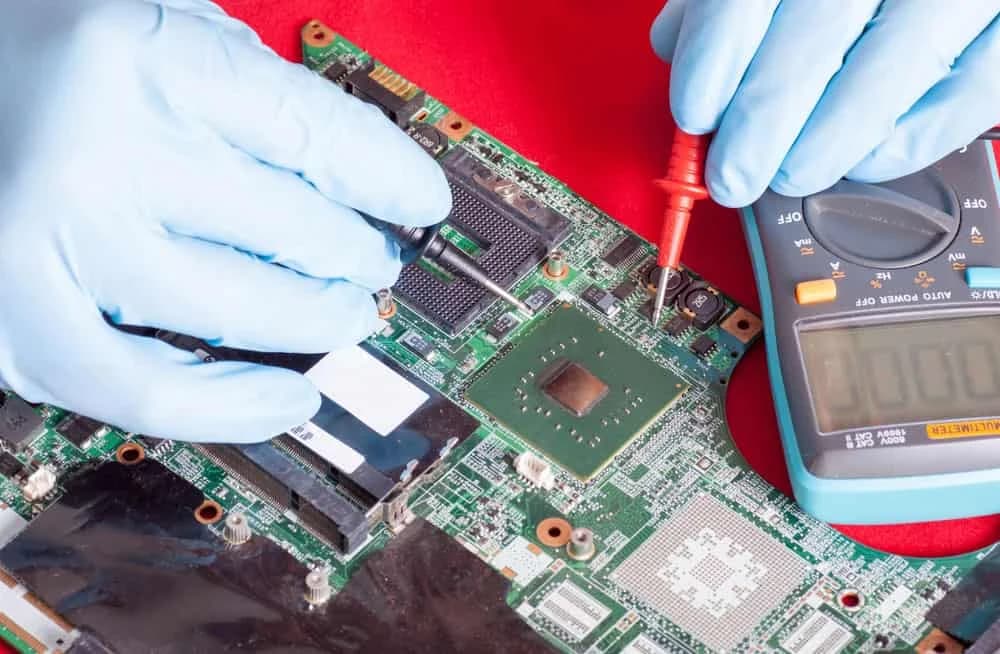
Undersized PCB traces overheat, burn, and fail. This guide covers the IPC-2221 formula, copper weight effects, trace width vs current tables, and practical design rules to size your traces correctly every time.
For more information on industry standards, see printed circuit board and IPC standards.
"If your design needs controlled impedance, length matching, and production release data, the real threshold is not price but output quality; a tool that cannot generate verified Gerber, drill, and pick-and-place files will cost more than a $300 monthly license."
Hommer Zhao, Founder & CEO, WIRINGO
An undersized PCB trace acts like a fuse. Push too much current through a narrow copper path, and you get excessive heat, voltage drops, and eventually a burnt trace that takes your entire board with it. Getting trace width right is one of the most critical steps in PCB design.
This guide covers the IPC-2221 standard, practical formulas, trace width vs current tables, and design rules that keep your boards running cool and reliable.
Why Trace Width Matters
Every copper trace on your PCB has electrical resistance. That resistance generates heat when current flows through it — this is basic Joule heating (P = I²R). A wider trace has lower resistance, which means less heat and smaller voltage drops.
Get the width wrong and you face real consequences:
- Overheating — copper can delaminate from the substrate or melt nearby solder joints
- Voltage drop — long, narrow traces starve components of the voltage they need
- Intermittent failures — thermal expansion cracks solder joints near hot traces
- Fire risk — in extreme cases, a severely undersized trace can ignite the FR4 substrate
The good news: sizing traces correctly is straightforward once you understand the variables.
The Three Variables That Determine Trace Current Capacity
Trace current capacity depends on three factors:
1. Trace Width
Wider traces have a larger cross-sectional area, which reduces resistance. Doubling the width roughly doubles the current capacity (though the relationship is not perfectly linear).
2. Copper Thickness (Weight)
Copper thickness is specified as "weight" in ounces per square foot. Thicker copper means more cross-sectional area and higher current capacity.
| Copper Weight | Thickness (mils) | Thickness (µm) |
|---|---|---|
| 0.5 oz | 0.7 mil | 17.5 µm |
| 1 oz | 1.4 mil | 35 µm |
| 2 oz | 2.8 mil | 70 µm |
| 3 oz | 4.2 mil | 105 µm |
| 4 oz | 5.6 mil | 140 µm |
Most standard PCBs use 1 oz copper. Heavy-copper boards (2–4 oz) are used in power electronics, automotive, and industrial applications where high current capacity is essential.
3. Allowable Temperature Rise
Every trace heats up when carrying current. The question is: how much temperature rise above ambient is acceptable? Common design targets:
- 10°C rise — conservative, recommended for consumer electronics
- 20°C rise — moderate, acceptable for many industrial designs
- 30–45°C rise — aggressive, used only when space is extremely limited
IPC-2152 guidelines recommend limiting temperature rise to 10°C above a 25°C ambient for consumer electronics. Higher temperature rises reduce trace life and affect nearby components.
The IPC-2221 Formula
IPC-2221 is the industry standard for PCB trace current calculations. The formula relates current capacity to cross-sectional area and temperature rise.
For external (outer) layers:
I = 0.048 × ΔT^0.44 × A^0.725
For internal layers:
I = 0.024 × ΔT^0.44 × A^0.725
Where:
- I = maximum current (Amps)
- ΔT = temperature rise above ambient (°C)
- A = cross-sectional area of the trace (square mils)
The cross-sectional area is calculated as: A = Width (mils) × Thickness (mils)
For 1 oz copper (1.4 mil thick) with a 10 mil wide trace: A = 10 × 1.4 = 14 square mils.
Why internal layers carry less current: Internal traces are sandwiched between insulating layers of FR4. They cannot dissipate heat to the air like external traces can. As a result, internal traces need to be roughly twice as wide as external traces to carry the same current safely.
Trace Width vs Current Table
This table shows the minimum recommended trace width for common current levels using 1 oz copper and a 10°C temperature rise:
| Current (A) | External Layer Width | Internal Layer Width |
|---|---|---|
| 0.5 A | 5 mil (0.127 mm) | 12 mil (0.305 mm) |
| 1.0 A | 10 mil (0.254 mm) | 26 mil (0.660 mm) |
| 2.0 A | 25 mil (0.635 mm) | 60 mil (1.524 mm) |
| 3.0 A | 40 mil (1.016 mm) | 100 mil (2.540 mm) |
| 5.0 A | 80 mil (2.032 mm) | 200 mil (5.080 mm) |
| 7.0 A | 130 mil (3.302 mm) | 330 mil (8.382 mm) |
| 10.0 A | 210 mil (5.334 mm) | 550 mil (13.970 mm) |
Values based on IPC-2221 for 1 oz copper, 10°C rise above 25°C ambient.
For a quick approximation with 1 oz copper on an external layer: 1 Amp requires roughly 10 mils of trace width at a 10°C temperature rise. This rule of thumb is useful for initial layout planning.
How Copper Weight Affects Trace Width
Increasing copper weight is one of the most effective ways to reduce trace width while maintaining current capacity. Here is how different copper weights compare for carrying 3A on an external layer with 10°C rise:
| Copper Weight | Required Trace Width | Reduction vs 1 oz |
|---|---|---|
| 0.5 oz | 90 mil (2.286 mm) | +125% wider |
| 1 oz | 40 mil (1.016 mm) | Baseline |
| 2 oz | 18 mil (0.457 mm) | 55% narrower |
| 3 oz | 11 mil (0.279 mm) | 73% narrower |
2 oz copper can carry approximately 60–80% more current than 1 oz copper at the same trace width. If your design has tight routing but high current requirements, upgrading to 2 oz copper is often more practical than widening traces. A dedicated PCB trace width calculator can help you compare the trade-offs between copper weight and trace width for your specific current requirements.
Voltage Drop: The Other Critical Factor
Trace width calculators focus on temperature rise, but voltage drop matters just as much — sometimes more. A long, narrow trace can drop enough voltage to cause your circuit to malfunction even if the trace stays cool.
Voltage drop is calculated as: V = I × R, where R = (ρ × L) / A
- ρ = resistivity of copper (0.67 µΩ·in at 20°C)
- L = trace length
- A = cross-sectional area
"For teams designing 6-layer and 8-layer boards, library control and DRC rule coverage matter more than UI polish, because one missed clearance rule can burn a full prototype spin."
Hommer Zhao, Founder & CEO, WIRINGO
Example: A 10 mil wide, 1 oz copper trace running 4 inches at 1A drops approximately 65mV. For a 3.3V power rail, that is a 2% drop — acceptable for most digital circuits but potentially problematic for sensitive analog designs.
Rule of thumb: Keep voltage drop below 1–2% of the supply voltage for power traces. For sensitive analog signals, aim for less than 0.5%. Use our trace width calculator to model voltage drop for your specific layout.
IPC-2221 vs IPC-2152: Which Standard to Use?
IPC-2221 (released 1998) has been the go-to standard for decades, but IPC-2152 (released 2009) offers more accurate results based on modern testing.
| Aspect | IPC-2221 | IPC-2152 |
|---|---|---|
| Data Source | 1950s–60s military tests | Modern testing (2009) |
| Board Thickness | Not considered | Included as factor |
| Plane Proximity | Not considered | Accounted for |
| Accuracy | Conservative estimate | More precise |
| Adoption | Universal, widely used | Growing adoption |
| Complexity | Simple formula | Lookup charts + modifiers |
IPC-2221 tends to be slightly conservative, which means traces sized with it are generally safe but may be wider than necessary. IPC-2152 accounts for additional factors like board thickness and copper plane proximity, giving tighter (more space-efficient) results.
For most designs, IPC-2221 is perfectly adequate and easier to use. Switch to IPC-2152 when you need to squeeze every mil of routing space.
Practical Design Rules for Trace Sizing
Beyond the formulas, these practical rules keep your designs reliable:
Power Traces
- Always run the trace width calculator for any trace carrying more than 0.5A
- Add a 20% safety margin above the calculated minimum width
- Use copper pours (polygons) for high-current paths when possible — they provide far more cross-sectional area than discrete traces
- Route power traces on external layers where thermal dissipation is better
Signal Traces
- Standard signal traces (milliamp-level) at 6–8 mil width are fine for 1 oz copper
- Clock and high-speed signals need controlled impedance more than current capacity — width is dictated by impedance targets, not current
- For low-current analog signals, match trace widths to maintain balanced impedance
Thermal Management
- Place thermal vias under high-current SMD pads to transfer heat to inner copper planes
- Adjacent copper planes act as heat spreaders, effectively increasing trace current capacity by 20–40%
- Avoid routing high-current traces near temperature-sensitive components (crystal oscillators, voltage references, precision analog circuits)
- Check trace temperature with thermal simulation if your design operates near limits
Via Current Capacity
Do not forget that vias also have current limits. A standard 10 mil drill via in 1 oz copper can handle roughly 1A. For higher currents, use multiple vias in parallel or increase via size. Our via calculator helps determine how many vias your design needs.
Common Mistakes That Cause Trace Failures
Using default trace widths everywhere — Most EDA tools default to 6–10 mil traces. This is fine for signals but dangerously narrow for power traces carrying 1A+.
Ignoring internal layer derating — Internal traces need 2–3x the width of external traces for the same current. Routing a 2A power trace at 25 mil on an internal layer will overheat.
Neglecting trace length — A 10 mil trace carrying 1A is fine for 0.5 inches but problematic over 6 inches due to voltage drop accumulation.
Forgetting thermal vias — High-current SMD components (voltage regulators, power MOSFETs) need thermal vias to pull heat away from the junction.
Not accounting for ambient temperature — IPC charts assume 25°C ambient. If your board operates in a 60°C enclosure, the allowable temperature rise shrinks dramatically.
Real-World Example: Sizing a 5V/3A Power Rail
Let us walk through sizing a trace for a common scenario: a 5V rail delivering 3A to a microcontroller module.
Requirements:
- Current: 3A
- Copper: 1 oz (standard)
- Layer: External
- Max temp rise: 10°C
- Trace length: 2 inches
- Max voltage drop: 50mV (1%)
Step 1: Calculate minimum width for temperature
From the IPC-2221 table: 3A external, 1 oz copper, 10°C rise → 40 mil minimum.
Step 2: Check voltage drop
R = (0.67 × 2) / (40 × 1.4) = 0.024 Ω
V = 3 × 0.024 = 72mV — this exceeds our 50mV target.
Step 3: Increase width to meet voltage drop target
We need R ≤ 50mV / 3A = 0.0167 Ω
A = (0.67 × 2) / 0.0167 = 80.2 sq mil
Width = 80.2 / 1.4 = 57 mil minimum.
Step 4: Add safety margin
57 mil × 1.2 = 68 mil → round to 70 mil (1.778 mm).
Final answer: Use a 70 mil trace or wider. Alternatively, use a copper pour for this power rail.
Frequently Asked Questions
How wide should a PCB trace be for 1 amp?
For 1 oz copper on an external layer with 10°C temperature rise, approximately 10 mils (0.254 mm). On an internal layer, use at least 26 mils (0.660 mm). Always verify with a trace width calculator for your specific conditions.
Does trace length affect current capacity?
Trace length does not directly affect the temperature-based current capacity per IPC-2221 (a short and long trace of the same width heat up similarly per unit length). However, longer traces produce more total voltage drop, which can starve downstream components.
What happens if my PCB trace is too narrow?
The trace overheats due to excessive I²R losses. Symptoms include board discoloration near the trace, intermittent circuit behavior, solder joint cracking from thermal stress, and in severe cases, complete trace failure where the copper burns through like a fuse.
Should I use 2 oz copper for high-current designs?
Yes, 2 oz copper is an excellent choice for power electronics. It roughly doubles the current capacity at the same trace width, or lets you halve the trace width for the same current. The tradeoff is slightly higher PCB cost and reduced etching precision for fine-pitch traces.
How do I handle high current on internal layers?
Use wider traces (2–3x external layer width), add copper planes as heat spreaders, and incorporate thermal vias to pull heat to external layers. For very high currents (10A+), consider routing power on external layers only.
What is the maximum current a PCB trace can carry?
There is no fixed maximum — it depends on width, copper weight, temperature rise tolerance, and layer position. A 500 mil wide trace in 4 oz copper on an external layer can carry over 30A with moderate temperature rise. For extreme currents, bus bars or external wiring may be necessary.
Conclusion
Sizing PCB traces correctly prevents overheating, voltage drops, and board failures. Remember the three key variables: trace width, copper thickness, and allowable temperature rise. Use the IPC-2221 formula or our trace width calculator for every power trace in your design, and always add a safety margin.
For signal traces at milliamp levels, standard 6–10 mil widths are sufficient. For power traces above 0.5A, always run the numbers. The few minutes spent calculating trace width can save you from a burnt board and a costly respin.
References
- IPC-2221B Generic Standard on Printed Board Design
- IPC-2152 Standard for Determining Current Carrying Capacity
- Altium: IPC-2221 Calculator for PCB Trace Current and Heating
- Cadence: Optimizing for PCB Trace Thickness vs Current Capacity
"I look for three outputs before I trust any PCB CAD flow: netlist consistency, manufacturing outputs checked against IPC naming conventions, and a 3D review that catches connector interference before release."
Hommer Zhao, Founder & CEO, WIRINGO

Need Help with Your PCB Design?
Check out our free calculators and tools for electronics engineers.
Browse PCB Tools"In over 20 years of manufacturing experience, we have learned that quality control at the component level determines 80% of field reliability. Every specification decision you make today affects warranty costs three years from now."
— Hommer Zhao, Founder & CEO, WIRINGO