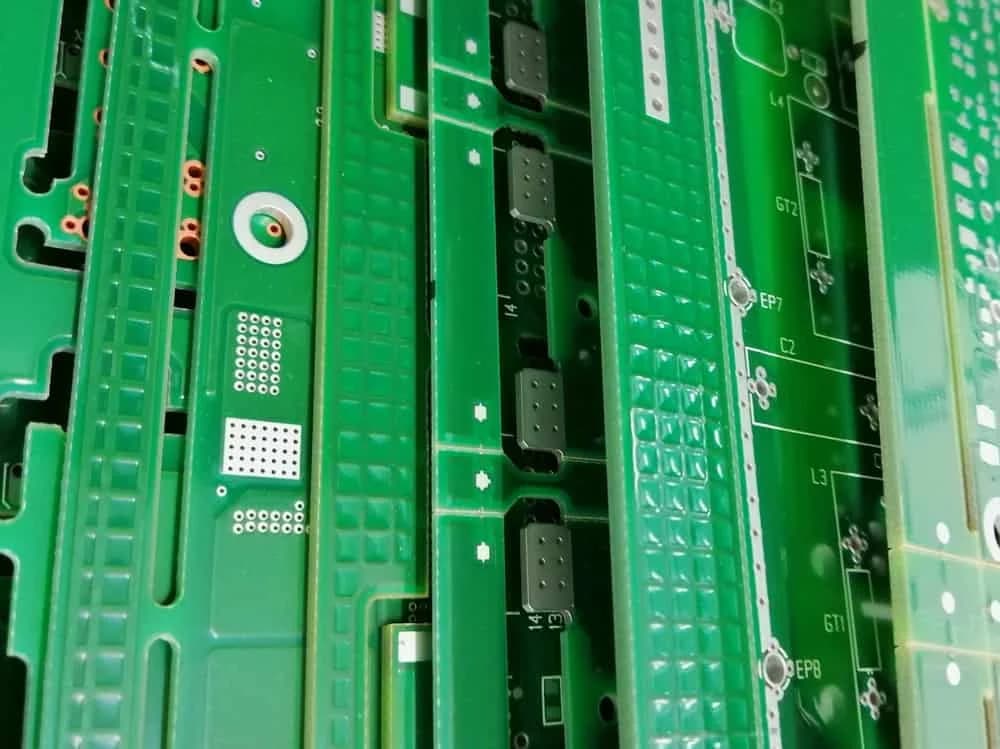
PCB Material Guide: FR-4, High-Tg, Rogers, Polyimide, Aluminum, and Ceramic Compared
PCB material selection sets loss, thermal behavior, warpage risk, CAF margin, and cost long before fabrication starts. This guide compares FR-4, high-Tg epoxy, Rogers laminates, polyimide, aluminum-core, and ceramic PCB materials so engineers can match laminate choice to frequency, temperature, reliability, and assembly reality.
For more information on industry standards, see printed circuit board and IPC standards.
If a board will see sustained temperatures above about 130 C, I stop talking about material as a generic FR-4 choice and start reviewing Tg, Z-axis expansion, and assembly heat together. Many field failures blamed on solder or layout actually begin with the wrong laminate.
A power-conversion customer once approved a low-cost FR-4 stack because the bare-board quote looked fine and the design passed bench bring-up. Six months later, the same assembly started showing intermittent BGA opens after thermal cycling. The root cause was not the BGA package, the stencil, or the reflow recipe. It was the board material. The laminate's glass transition temperature was too close to the operating profile, Z-axis expansion rose sharply during repeated soldering and power cycling, and the vias and joints took the stress.
That is why PCB material selection matters more than many teams expect. A laminate is not just the thing that holds copper in place. It controls dielectric constant, dissipation factor, moisture behavior, coefficient of thermal expansion, CAF resistance, dimensional stability, and how much process margin the board has during lamination, drilling, plating, reflow, and long-term use.
This guide explains the main PCB material families used in production today, where each one makes sense, and where engineers waste money by over-specifying them. If you need adjacent references, review our PCB stackup guide, rigid PCB explained article, surface finish reference, and 4 layer PCB manufacturing page before freezing a fabrication package.
What Is a PCB Material?
PCB material usually refers to the insulating substrate and prepreg system that support copper circuitry inside a printed circuit board. In a standard rigid multilayer board, that means glass reinforcement plus a resin system such as epoxy. In other constructions, it may mean PTFE-based high-frequency laminates, polyimide for flex and high-temperature work, metal-core structures for thermal spreading, or ceramic substrates for extreme heat and RF stability.
In practice, the right PCB material has to satisfy six conditions at the same time:
- Hold the required dielectric performance for the signals involved.
- Survive the assembly temperature profile without excessive expansion or warpage.
- Match the product's operating temperature, humidity, and reliability target.
- Fit the layer count, hole structure, and fabrication process capability.
- Stay available at realistic lead times and cost.
- Avoid creating hidden failure modes such as CAF growth, pad lift, or delamination.
For standards and background, printed circuit board, FR-4, Rogers Corporation, and alumina are useful references because material behavior is tied directly to frequency, heat, and manufacturing method.
PCB Materials Comparison Table
The fastest way to narrow the field is to compare the common families by temperature capability, electrical loss, and manufacturing cost.
| Material family | Typical Tg or thermal limit | Main strength | Main weakness | Best use | Practical note |
|---|---|---|---|---|---|
| Standard FR-4 | Tg about 130 C to 140 C common | Lowest cost, broad availability, good general manufacturability | Higher loss and lower thermal margin | General digital boards, industrial controls, low-to-mid speed electronics | Fine for most products that do not run hot or at very high frequency |
| High-Tg FR-4 | Tg about 170 C to 180 C common | Better reflow and thermal-cycling margin | Costs more than standard FR-4 and still not low-loss RF material | Power electronics, thicker boards, lead-free assembly, automotive support boards | Often the best upgrade when heat is the main concern |
| Low-loss / Rogers-class RF laminate | Material dependent, often stable to high temp | Lower Df, stable Dk, stronger RF performance | Higher cost, mixed-stackup complexity | RF, microwave, antennas, high-speed low-loss channels | Do not specify it for an entire board unless the loss budget really requires it |
| Polyimide | High thermal capability, often 200 C class and above | Excellent heat resistance and useful for flex builds | More moisture sensitivity, more expensive processing | Flex circuits, rigid-flex, aerospace, harsh thermal cycles | Process control matters because moisture and handling can ruin yield |
| Aluminum-core PCB | Metal base for heat spreading rather than high Tg alone | Excellent thermal path for LEDs and power modules | Limited multilayer complexity, poor fit for dense digital routing | LED lighting, motor drivers, power conversion | Strong thermal answer, not a signal-integrity upgrade |
| Ceramic PCB | Very high thermal stability and excellent dimensional control | Outstanding heat handling and RF stability | High cost, brittle, specialized process | High-power modules, RF hybrids, extreme-temperature electronics | Usually justified only when FR-4-class systems cannot survive |
That table shows the real rule: there is no universal best PCB material. There is only the best material for the electrical, thermal, mechanical, and cost target you actually have.
1. Standard FR-4: The Default for Good Reason
FR-4 remains the standard PCB material because it balances cost, supply chain stability, mechanical strength, and manufacturability better than almost anything else. For most commercial and industrial products below a few gigahertz and below sustained high temperature, standard FR-4 is still the correct first option.
The problem starts when teams confuse common with universal. Standard FR-4 can be perfectly adequate for a 4-layer controller board operating at 55 C ambient, but marginal for a heavy copper design that sees repeated lead-free reflow, 125 C local hotspots, and fine-pitch BGA escape routing on a thick stackup. The resin system matters.
If your product is a typical digital or mixed-signal board, standard FR-4 should usually be the baseline. If the design is hot, thick, or frequency-sensitive, then the conversation needs to move beyond generic FR-4 immediately.
2. High-Tg FR-4: Often the Smart Upgrade
High-Tg epoxy laminates are still FR-4-class materials, but with better thermal margin. That matters during lead-free assembly, multiple reflow passes, selective soldering, and long-term service in hotter environments. They are especially useful in power supplies, automotive-adjacent electronics, and denser multilayer boards where through-hole reliability is stressed by Z-axis expansion.
This is one of the most practical material upgrades because it improves process robustness without forcing the whole design into RF-laminate pricing. Many teams jump straight from standard FR-4 to exotic materials when the real issue is simply insufficient Tg and thermal stability.
For lead-free multilayers above about 1.6 mm, I usually want high-Tg material on the table by default. When a thick board sees 245 C to 255 C assembly peaks, the Z-axis expansion window matters more than the quote delta of a few percent.
High-Tg FR-4 is usually the right answer when the board is still fundamentally a conventional epoxy multilayer, but the thermal risk is no longer trivial.
3. Rogers and Other Low-Loss RF Materials: Use Them Where Loss Budget Matters
Rogers and similar low-loss laminates are chosen because high-frequency performance and dielectric stability matter more than low raw-board cost. Compared with standard FR-4, they typically offer lower dissipation factor, more stable dielectric constant over frequency, and better control for microwave structures, antennas, and high-speed channels where insertion loss matters.
Their limitation is not only price. Mixed-material stackups become more complex to design and manufacture. Bonding films, drill behavior, copper balancing, and hybrid stack reliability all become part of the DFM conversation. A hybrid board with RF laminate only where needed is often smarter than building the entire product on expensive low-loss material.
If the application includes radar, RF front ends, microwave filters, or long high-speed channels where every dB matters, low-loss laminate earns its place. If the board is a low-frequency industrial controller, it usually does not.
4. Polyimide: Built for Heat and Flex, Not for Casual Use
Polyimide is common in flex circuits, rigid-flex products, and some high-temperature assemblies because it handles thermal stress better than standard epoxy systems. It is also central to flex construction, which is why our flex circuit manufacturer page treats material choice, bend zone geometry, and stiffener design as one engineering package rather than separate decisions.
The weakness is process sensitivity. Polyimide systems can absorb more moisture, require disciplined storage and baking, and cost more to process. That means polyimide should be chosen because the product truly needs its thermal or flex behavior, not because it sounds premium.
For rigid-flex, dynamic bending, or harsh thermal cycling, polyimide is often the correct answer. For a static office product, it is usually unnecessary cost.
5. Aluminum-Core PCB Materials: A Thermal Solution, Not a Universal Upgrade
Aluminum-core boards are often specified when the real design problem is heat extraction, especially in LED lighting, motor drives, and power conversion modules. The structure typically uses a copper circuit layer over a thermally conductive dielectric bonded to an aluminum base plate. That lets heat move into the chassis more effectively than a conventional FR-4 board can manage.
What aluminum-core material does not do is solve every electrical problem. It is not the right answer for complex multilayer routing, dense digital breakout, or high pin-count logic. It helps thermal management first.
If your design is constrained by junction temperature or thermal spreading, an MCPCB may be exactly right. If the problem is impedance control, layer density, or RF loss, it is the wrong tool. For those thermal-heavy applications, our aluminium PCB manufacturer page is the more relevant next step than a generic stackup discussion.
6. Ceramic PCB Materials: High-End Performance for Harsh Conditions
Ceramic substrates such as alumina and aluminum nitride are used where standard organic laminates cannot provide enough thermal conductivity, dimensional stability, or high-temperature reliability. They are common in power modules, hybrid circuits, RF packages, and applications where the board must survive temperatures and thermal gradients that would punish epoxy-based systems.
The tradeoff is cost and brittleness. Ceramic solutions usually require specialized process capability and make sense only when the operating environment truly demands them.
That is why ceramic should be viewed as an engineering necessity material, not a prestige material.
Ceramic is what I reach for when the laminate is part of the thermal design, not just the support structure. If your substrate decision changes junction temperature by 10 C or more, you are no longer in a normal FR-4 discussion.
The Material Properties That Actually Matter
Most PCB material mistakes happen because teams specify by name only and skip the property review. In production, five properties dominate the decision.
1. Tg, Td, and thermal expansion
Tg is the glass transition region where resin behavior changes sharply. Td relates to decomposition at much higher temperature. Neither number alone is enough. You also need to understand Z-axis expansion because plated through-holes, vias, and solder joints are stressed when the laminate expands during assembly and field use.
2. Dk and Df
Dielectric constant and dissipation factor matter for impedance and high-frequency loss. If you are building RF paths or long fast digital channels, this is where material choice becomes electrically visible instead of just mechanically relevant.
3. Moisture absorption
Materials that absorb more moisture carry higher process risk during reflow and long-term reliability risk in humid environments. This matters for polyimide, thick multilayers, and any product stored or operated in difficult conditions.
4. CAF resistance
Conductive anodic filament growth is not an academic issue on high-density boards. Tight spacing, humidity, DC bias, and weak material systems can turn laminate selection into a latent field-failure problem.
5. Cost and supply stability
A technically superior laminate that adds 12 weeks to the lead time or forces a niche factory path may be the wrong business decision for a general product. Material selection is always engineering plus procurement, never engineering alone.
How To Choose the Right PCB Material
A practical material-selection process usually comes down to six questions.
1. What temperature will the board actually see?
Use hotspot and enclosure reality, not just room-temperature bench tests. A board living near MOSFETs, LEDs, or power resistors may need more thermal margin than its average ambient suggests.
2. How fast are the signals?
High-speed serial channels, antennas, and RF front ends expose dielectric loss quickly. Slow digital control boards usually do not need exotic low-loss laminate.
3. How many reflow cycles and what board thickness are planned?
A 2.4 mm board with heavy copper and multiple thermal cycles stresses the material much more than a light 1.0 mm board built once.
4. Is this a flex, rigid-flex, or thermally managed design?
If the answer is yes, material selection stops being a standard FR-4 conversation.
5. What reliability target applies?
Industrial, automotive, aerospace, and long-service products often justify better thermal and moisture margin even when the circuit could function on cheaper laminate.
6. Can the intended factory source and process it reliably?
A theoretically correct material still fails the project if the chosen supply chain cannot laminate, drill, bond, and test it repeatably.
Common Mistakes When Choosing PCB Materials
The first mistake is specifying "FR-4" with no property targets. FR-4 is a material family, not a single performance number. Two FR-4 systems can behave very differently in Tg, Dk, Z-axis expansion, and CAF resistance.
The second mistake is selecting RF laminate because a design feels advanced, even though the actual frequencies and trace lengths do not justify the cost. Material prestige is not engineering.
The third mistake is ignoring assembly heat. A board can pass simulation and still fail because the laminate does not survive lead-free processing or repeated service temperature cycles gracefully.
The fourth mistake is separating material from stackup. Laminate choice, dielectric thickness, copper weight, and impedance control must be reviewed together, which is why our PCB stackup guide belongs in the same decision loop.
The fifth mistake is treating aluminum-core as a universal power-electronics answer. It is excellent for thermal spreading, but it does not replace a proper multilayer digital architecture.
A Short Selection Shortcut
If you need a fast first pass, use this shortcut:
- Use standard FR-4 for ordinary digital and mixed-signal boards with modest thermal load.
- Use high-Tg FR-4 when lead-free thermal stress, board thickness, or service temperature is elevated.
- Use Rogers-class or other low-loss laminate only where RF or insertion-loss targets demand it.
- Use polyimide for flex, rigid-flex, and true high-temperature duty.
- Use aluminum-core materials when the board is part of the heat path.
- Use ceramic only when organic laminates cannot meet thermal or dimensional requirements.
Then validate the choice against stackup, via structure, assembly profile, reliability target, and sourcing reality before release.
FAQ
Q: What is the most common PCB material?
The most common PCB material is FR-4, a glass-reinforced epoxy laminate used across consumer, industrial, and commercial electronics. It remains the default because it balances cost, strength, insulation performance, and manufacturability for the majority of boards built below high-RF ranges and below sustained high-temperature service.
Q: When should I choose high-Tg FR-4 instead of standard FR-4?
Choose high-Tg FR-4 when the board sees lead-free reflow around 245 C to 255 C, repeated thermal cycling, thicker multilayer construction, or hotter operating conditions. In practice, it is often justified for power electronics, automotive-adjacent assemblies, and any design where standard Tg material would run too close to the process or service temperature margin.
Q: Is Rogers material always better than FR-4?
No. Rogers-class laminate is better only when lower loss, more stable dielectric behavior, or RF performance is actually required. For many digital boards under a few gigahertz and modest trace lengths, the cost premium is unnecessary and the manufacturing path becomes more complicated without delivering a real product benefit.
Q: What PCB material is best for heat dissipation?
For many practical products, aluminum-core PCB material is the best first answer when the board must spread heat from LEDs or power devices into a chassis. Ceramic materials can outperform it thermally in specialized designs, but the process and cost are much higher. The right answer depends on whether the board is mainly a heat spreader, a routing platform, or both.
Q: Does PCB material affect impedance and signal loss?
Yes. Material choice directly affects dielectric constant, dissipation factor, and therefore trace impedance and insertion loss. At 50 ohm or 90 ohm controlled-impedance targets, a change in dielectric thickness or resin system can shift trace geometry significantly, and high-frequency loss becomes visible much faster on standard FR-4 than on lower-loss RF laminates.
Q: Can I use the same PCB material for prototype and production?
Usually yes, and you should whenever possible. Changing material between prototype and production can shift impedance, warpage behavior, drill quality, and assembly yield. If a substitute is unavoidable, compare Tg, Dk, Df, copper foil style, and thickness system carefully before assuming the boards are interchangeable.
If you are choosing between standard FR-4, high-Tg epoxy, RF laminate, polyimide, or metal-core construction, send the stackup target, operating temperature, and frequency range before release. We can review the material, stackup, and manufacturing route as one package. Contact YourPCB for a DFM review or quotation.
Need Help with Your PCB Design?
Check out our free calculators and tools for electronics engineers.
Browse PCB Tools"In over 20 years of manufacturing experience, we have learned that quality control at the component level determines 80% of field reliability. Every specification decision you make today affects warranty costs three years from now."
— Hommer Zhao, Founder & CEO, WIRINGO