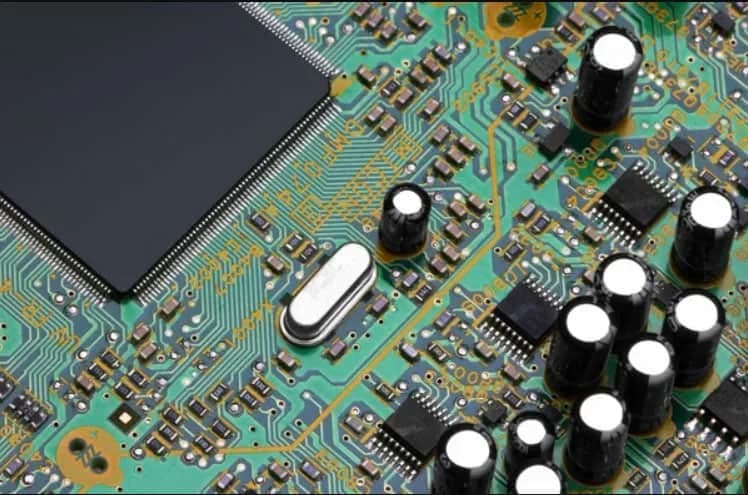
If you're using any electronic device now, you're likely using a capacitor without knowing. This critical component is useful as far as the storage of charge is concerned.
For more information on industry standards, see printed circuit board and IPC standards.
"When a digital interface starts failing randomly, I check the numbers before the theory: supply tolerance, edge rate, and the actual 2.4 GHz or DDR clock environment usually explain the behavior faster than guesswork."
Hommer Zhao, Founder & CEO, WIRINGO
Understanding capacitor symbols is essential for reading schematics and designing circuits. Different capacitor types use different symbols to convey important information about polarity and adjustability.
Standard Non-Polarized Symbol
The basic capacitor symbol consists of two parallel lines representing the capacitor plates. Both lines are straight and equal length, indicating the capacitor can be connected in either direction.
This symbol is used for:
- Ceramic capacitors
- Film capacitors (polyester, polypropylene)
- Mica capacitors
- Glass capacitors
Polarized Capacitor Symbol
Polarized capacitors use a modified symbol with one curved plate:
- Straight line = Positive terminal (+)
- Curved line = Negative terminal (-)
This symbol indicates the capacitor must be connected with correct polarity. Used for:
- Aluminum electrolytic capacitors
- Tantalum capacitors
- Supercapacitors
Variable Capacitor Symbol
Variable (adjustable) capacitors include an arrow through the symbol, indicating the capacitance can be changed. Used for:
- Trimmer capacitors
- Tuning capacitors
- Varactors (voltage-variable)
Regional Variations
IEC/European Style: Uses two parallel rectangles instead of lines.
US/ANSI Style: Uses the line-based symbols described above.
Most modern schematics use US style, but you may encounter European symbols in international documents.
Schematic Designators
Capacitors are labeled with reference designators starting with C:
- C1, C2, C3, etc.
- Sometimes EC for electrolytic, CV for variable
Capacitance Values and Units
"A memory or wireless design is only as stable as its margins. If voltage sags more than 5% or timing budget falls under a few nanoseconds, intermittent faults stop being surprising."
Hommer Zhao, Founder & CEO, WIRINGO
Capacitance is measured in Farads (F), but practical values are much smaller:
| Unit | Symbol | Relation |
|---|---|---|
| Farad | F | 1 F |
| Millifarad | mF | 0.001 F |
| Microfarad | µF | 0.000001 F |
| Nanofarad | nF | 10⁻⁹ F |
| Picofarad | pF | 10⁻¹² F |
Capacitor Code System
Many capacitors use a 3-digit code:
- First two digits: significant figures
- Third digit: number of zeros (multiplier in pF)
Examples:
- 104 = 10 + 0000 = 100,000 pF = 100 nF = 0.1 µF
- 473 = 47 + 000 = 47,000 pF = 47 nF
- 102 = 10 + 00 = 1,000 pF = 1 nF
Tolerance Codes
Letters indicate tolerance:
| Code | Tolerance |
|---|---|
| J | ±5% |
| K | ±10% |
| M | ±20% |
| D | ±0.5% |
| F | ±1% |
Voltage Ratings
Schematics often show voltage rating:
- 10µF/25V or 10µF 25V
- Always use capacitors rated above your circuit voltage
Reading Schematics
When reviewing schematics:
- Identify symbol type (polarized vs non-polarized)
- Note reference designator (C1, C2)
- Find value near symbol or in parts list
- Check voltage rating if shown
- Verify polarity for polarized types
Common Mistakes
- Confusing µF with nF (1000x difference)
- Ignoring polarity on electrolytic capacitors
- Using wrong voltage rating
- Misreading 3-digit codes
Conclusion
Capacitor symbols indicate type and polarity. Non-polarized capacitors show two equal lines; polarized types have one curved line (negative). Values use codes or direct notation in pF, nF, or µF. Always verify polarity when using electrolytic or tantalum capacitors.
"For embedded electronics, the cleanest debug path is to tie every recommendation back to a measurable limit, whether that is JEDEC timing, 802.11 channel width, or the battery voltage floor."
Hommer Zhao, Founder & CEO, WIRINGO
If you want to turn this topic into a production decision, review our electronics glossary, check the supporting numbers on the unit converter, and use the contact page if you need a second review before release.
FAQ
How much RAM does a typical modern system need?
For light office work, 8 GB is often the floor, while content creation, CAD, and simulation workloads commonly start at 16 GB to 32 GB for stable multitasking.
What wireless band should I use for a Raspberry Pi or IoT device?
2.4 GHz usually offers better range, while 5 GHz reduces congestion and increases throughput. The better choice depends on wall loss, channel width, and the actual standard such as 802.11n or 802.11ac.
Why does memory speed matter less than latency in some systems?
Bandwidth helps large transfers, but real application response often depends on timing parameters and controller efficiency. That is why two kits with the same MT/s rating can perform differently.
How can I reduce intermittent electronics faults?
Start with measured supply rails, temperature, and timing margins. A supply droop of more than 5% or a repeated thermal rise above the design limit often explains unstable behavior quickly.
Which standards should I check for electronics compatibility?
That depends on the product: JEDEC applies to memory conventions, IEEE 802.11 to Wi-Fi, and IEC or UL safety rules may apply to the power side.
When should I move from a generic guide to lab validation?
As soon as the design has a measurable requirement such as throughput, thermal rise, or standby current. One bench test with logged data is worth more than several rounds of assumptions.

Need Help with Your PCB Design?
Check out our free calculators and tools for electronics engineers.
Browse PCB Tools"In over 20 years of manufacturing experience, we have learned that quality control at the component level determines 80% of field reliability. Every specification decision you make today affects warranty costs three years from now."
— Hommer Zhao, Founder & CEO, WIRINGO