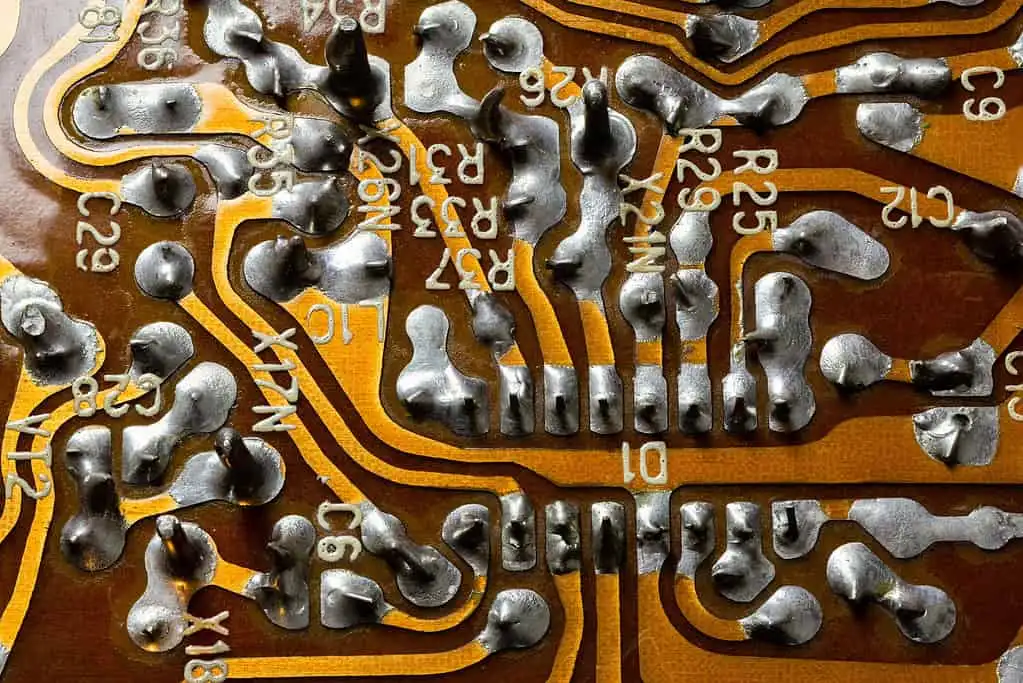
Types of Printed circuit board is all around us. They are in almost all electrical devices; in fact, you are probably using one right now!
For more information on industry standards, see printed circuit board and IPC standards.
"When a cable sees more than 10,000 flex cycles, I stop treating jacket material as a purchasing detail; bend radius, strand class, and insulation thickness become the actual reliability drivers."
Hommer Zhao, Founder & CEO, WIRINGO
Printed circuit boards come in many varieties, each suited to different applications. Understanding PCB types helps you choose the right solution for your project.
Classification by Layer Count
Single-Sided PCB
The simplest PCB type with copper on only one side.
Characteristics:
- Components on one side, traces on the other
- Lowest cost to manufacture
- Simple designs only (no crossing traces)
Applications: Simple consumer electronics, LED lighting, calculators.
Double-Sided PCB
Copper on both sides with plated through-holes (PTH) connecting layers.
Characteristics:
- More routing flexibility
- Higher component density
- Most common PCB type
Applications: Industrial controls, power supplies, automotive systems.
Multi-Layer PCB
Three or more copper layers laminated together.
Characteristics:
- Internal power and ground planes
- Complex routing possible
- Better signal integrity
Common Configurations: 4-layer, 6-layer, 8-layer, up to 50+ layers.
"A crimp that passes pull-force once is not enough. For production harnesses, the process has to hold conductor brush length, insulation support, and crimp height within the work instruction every shift."
Hommer Zhao, Founder & CEO, WIRINGO
Applications: Computers, smartphones, servers, networking equipment.
Classification by Flexibility
Rigid PCB
Traditional PCB on solid FR4 substrate. Cannot flex or bend, excellent mechanical support, most common.
Flexible PCB (Flex)
PCB on flexible polyimide substrate. Can bend and flex, thin and lightweight.
Applications: Wearables, cameras, smartphones, medical devices.
Rigid-Flex PCB
Combines rigid and flexible sections in one board. Eliminates connectors, enables 3D packaging.
Applications: Aerospace, military, medical implants.
Classification by Material
- FR4: Standard fiberglass-epoxy, most common
- High-Frequency: Rogers, PTFE for RF applications
- Metal Core: Aluminum base for thermal management
- Ceramic: For high-temperature applications
Choosing the Right Type
| Application | Recommended Type |
|---|---|
| Simple circuits | Single-sided |
| General electronics | Double-sided |
| Complex digital | Multi-layer |
| Moving parts | Flexible |
| 3D packaging | Rigid-flex |
| High power | Metal core |
French-speaking engineers can access assemblage PCB professionnel for local assembly services, while quick-turn needs are served by PCB prêt-à-l'emploi solutions.
Manufacturing involves substrate creation, copper lamination, trace etching, and insulation. Applications span electronics, computers, medical devices, and more.
"On portable cord and harness work, the standard matters as much as the drawing. UL 62, IPC/WHMA-A-620, and the connector maker's crimp spec each control a different failure mode."
Hommer Zhao, Founder & CEO, WIRINGO
If you want to turn this topic into a production decision, review our cable assembly guide, check the supporting numbers on the FFC cable reference, and use the wire harness manufacturing service if you need a second review before release.
FAQ
What bend radius should I use for flexible cable design?
For dynamic flex, many teams start around 10x to 20x the overall cable thickness, while static bend-to-install applications can tolerate tighter radii if the supplier approves the construction.
Which standard applies to wire harness workmanship?
IPC/WHMA-A-620 is the core acceptance document, and many customers also add UL, SAE, or connector-specific crimp specifications depending on the market.
How do I know whether a cable needs shielding?
If the line carries fast edges, switching currents, or operates near motors and inverters, shielding should be evaluated. A 360-degree termination usually performs better than a pigtail drain at higher frequencies.
What pull-force numbers matter on a crimped wire?
The exact value depends on conductor size and terminal series, but the production rule is simple: use the terminal maker's crimp-height window and verify pull-force with a calibrated tester.
When is FPC better than FFC?
FPC is usually the safer choice when the design needs controlled impedance, tighter than about 0.5 mm pitch features, dynamic flex life, or integrated components on the cable itself.
How much temperature margin should portable cord have?
For real industrial use, choose a cord whose jacket and insulation ratings exceed the worst-case environment, whether that means 60°C, 90°C, or oil- and water-resistant service under UL 62 or NEC Article 400.

Need Help with Your PCB Design?
Check out our free calculators and tools for electronics engineers.
Browse PCB Tools"In over 20 years of manufacturing experience, we have learned that quality control at the component level determines 80% of field reliability. Every specification decision you make today affects warranty costs three years from now."
— Hommer Zhao, Founder & CEO, WIRINGO