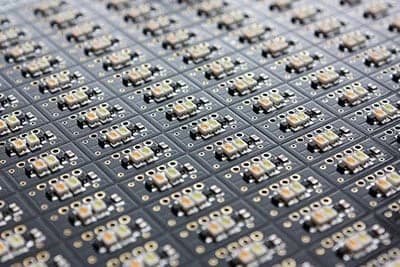
Aluminum PCBs offer superior thermal management for LED and power electronics applications. Learn about their benefits and uses...
For more information on industry standards, see printed circuit board and IPC standards.
"When a digital interface starts failing randomly, I check the numbers before the theory: supply tolerance, edge rate, and the actual 2.4 GHz or DDR clock environment usually explain the behavior faster than guesswork."
Hommer Zhao, Founder & CEO, WIRINGO
Aluminum PCBs, also known as metal-core PCBs (MCPCBs) or insulated metal substrates (IMS), represent a specialized PCB technology designed for superior thermal management. They're essential in applications where heat dissipation is critical.
What is an Aluminum PCB?
An aluminum PCB uses an aluminum alloy base layer instead of the traditional FR4 fiberglass. The structure typically consists of three layers: a copper circuit layer, a thermally conductive dielectric layer, and the aluminum base metal.
Structure Breakdown
Circuit Layer: Standard copper foil (1-10 oz) for electrical traces.
Dielectric Layer: A thin thermally conductive but electrically insulating layer (typically 75-200 µm). This is the critical component that transfers heat from components to the aluminum base.
Aluminum Base: Usually 1.0-3.2mm thick aluminum alloy (5052 or 6061) that acts as a heat spreader and provides mechanical support.
Thermal Performance
Aluminum PCBs dramatically outperform FR4 in thermal management:
| Material | Thermal Conductivity |
|---|---|
| FR4 | 0.3 W/mK |
| Aluminum PCB | 1-4 W/mK |
| Pure Aluminum | 205 W/mK |
The dielectric layer's thermal conductivity ranges from 1-4 W/mK depending on composition, significantly better than FR4's 0.3 W/mK.
Benefits of Aluminum PCBs
Superior Heat Dissipation: Heat spreads quickly across the aluminum base, preventing hot spots and extending component life.
Dimensional Stability: Aluminum expands and contracts predictably with temperature, reducing stress on solder joints.
"A memory or wireless design is only as stable as its margins. If voltage sags more than 5% or timing budget falls under a few nanoseconds, intermittent faults stop being surprising."
Hommer Zhao, Founder & CEO, WIRINGO
Mechanical Strength: More durable than FR4, resistant to warping and physical damage.
Weight Reduction: Despite being metal, aluminum PCBs can be thinner than equivalent FR4 designs with heatsinks.
EMI Shielding: The metal base provides inherent electromagnetic shielding.
Common Applications
LED Lighting: High-power LEDs generate significant heat. Aluminum PCBs are standard in LED bulbs, streetlights, automotive lighting, and commercial fixtures.
Power Electronics: Power supplies, motor drives, and converters benefit from improved thermal performance.
Automotive: Engine control units, LED headlights, and power systems in vehicles.
Audio Equipment: High-power amplifiers use aluminum PCBs to manage heat from power transistors.
Solar Inverters: High-efficiency power conversion requires excellent thermal management.
Design Considerations
When designing LED lighting products, working with experienced LED PCB manufacturers ensures optimal thermal management.
Single-Sided Only: Most aluminum PCBs are single-sided due to the metal base.
No Plated Through-Holes: Standard vias aren't possible; use thermal vias or edge-plating techniques.
Larger Minimum Features: Manufacturing tolerances are typically looser than standard FR4.
Conclusion
Aluminum PCBs are essential technology for any application requiring efficient heat removal. While more expensive than FR4, the improved thermal performance, reliability, and potentially eliminated heatsinks often make them cost-effective for high-power applications.
"For embedded electronics, the cleanest debug path is to tie every recommendation back to a measurable limit, whether that is JEDEC timing, 802.11 channel width, or the battery voltage floor."
Hommer Zhao, Founder & CEO, WIRINGO
If you want to turn this topic into a production decision, review our electronics glossary, check the supporting numbers on the unit converter, and use the contact page if you need a second review before release.
FAQ
How much RAM does a typical modern system need?
For light office work, 8 GB is often the floor, while content creation, CAD, and simulation workloads commonly start at 16 GB to 32 GB for stable multitasking.
What wireless band should I use for a Raspberry Pi or IoT device?
2.4 GHz usually offers better range, while 5 GHz reduces congestion and increases throughput. The better choice depends on wall loss, channel width, and the actual standard such as 802.11n or 802.11ac.
Why does memory speed matter less than latency in some systems?
Bandwidth helps large transfers, but real application response often depends on timing parameters and controller efficiency. That is why two kits with the same MT/s rating can perform differently.
How can I reduce intermittent electronics faults?
Start with measured supply rails, temperature, and timing margins. A supply droop of more than 5% or a repeated thermal rise above the design limit often explains unstable behavior quickly.
Which standards should I check for electronics compatibility?
That depends on the product: JEDEC applies to memory conventions, IEEE 802.11 to Wi-Fi, and IEC or UL safety rules may apply to the power side.
When should I move from a generic guide to lab validation?
As soon as the design has a measurable requirement such as throughput, thermal rise, or standby current. One bench test with logged data is worth more than several rounds of assumptions.

Need Help with Your PCB Design?
Check out our free calculators and tools for electronics engineers.
Browse PCB Tools"In over 20 years of manufacturing experience, we have learned that quality control at the component level determines 80% of field reliability. Every specification decision you make today affects warranty costs three years from now."
— Hommer Zhao, Founder & CEO, WIRINGO