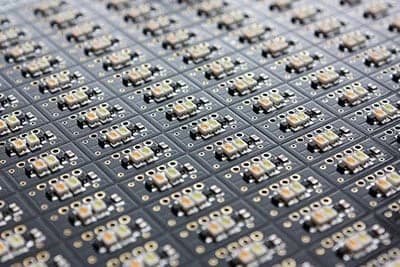
Aluminum LED PCBs provide superior thermal management for high-power LED applications. Learn about their construction, benefits, design considerations, and when to choose them over standard FR4 boards.
For more information on industry standards, see printed circuit board and IPC standards.
"When a digital interface starts failing randomly, I check the numbers before the theory: supply tolerance, edge rate, and the actual 2.4 GHz or DDR clock environment usually explain the behavior faster than guesswork."
Hommer Zhao, Founder & CEO, WIRINGO
Ever wonder why your high-power LED flashlight doesn't melt itself? Or how streetlights run all night without burning out? The secret is often hiding beneath the LEDs: an aluminum PCB silently managing enormous amounts of heat.
Aluminum PCBs—also called metal core PCBs (MCPCBs)—have become essential in LED lighting applications. This guide explains why they exist, how they work, and when you need one.
What is an Aluminum PCB?
An aluminum PCB replaces the traditional FR4 (fiberglass-reinforced epoxy) substrate with an aluminum base. The structure consists of three main layers:
- Circuit layer: Standard copper foil where traces are etched (typically 1-10 oz copper)
- Dielectric layer: Thermally conductive but electrically insulating material
- Aluminum base: The metal substrate that conducts heat away from components
The aluminum base typically comprises 60-85% of the total board thickness, providing a massive thermal pathway compared to standard PCBs.
Why LEDs Need Aluminum PCBs
LEDs are efficient, but "efficient" doesn't mean "cool." A typical LED converts about 30-40% of electrical power into light—the rest becomes heat. Pack enough LEDs together, and you've got a serious thermal challenge.
Heat is the enemy of LED longevity. Every 10°C increase in junction temperature roughly halves LED lifespan. Without proper thermal management, those "50,000-hour" LEDs might fail in a fraction of that time.
The Thermal Conductivity Advantage
Here's where aluminum PCBs shine (pun intended). Thermal conductivity comparisons:
| Material | Thermal Conductivity |
|---|---|
| FR4 (standard PCB) | 0.3 W/mK |
| Aluminum | 180-220 W/mK |
| Copper | 380-400 W/mK |
Aluminum conducts heat roughly 600 times better than FR4. This difference transforms thermal management from a constant struggle into a solved problem.
The dielectric layer in aluminum PCBs typically achieves 1-3 W/mK thermal conductivity—still far better than FR4, while maintaining necessary electrical isolation.
Types of Aluminum PCBs
Single-Sided Aluminum PCB
The most common type for LED applications. One layer of copper circuitry sits atop the dielectric and aluminum base. LEDs mount on the copper side, and heat flows directly into the aluminum.
Applications: LED bulbs, linear light bars, simple lighting fixtures
Double-Sided Aluminum PCB
Copper layers on both sides of the dielectric, with the aluminum base beneath. Allows more complex routing but adds manufacturing complexity.
Applications: LED drivers combined with LED arrays, multi-function boards
Hybrid Aluminum PCB
Combines aluminum and FR4 sections in one board. The LED section uses aluminum for thermal management, while the driver section uses FR4 for multilayer routing.
Applications: Integrated LED modules with onboard drivers, compact fixtures
Flexible Aluminum PCB
Uses thin aluminum substrates that can bend to fit curved housings. More expensive but enables designs impossible with rigid boards.
Applications: Automotive headlights with curved shapes, architectural lighting, wearable lights
Key Benefits for LED Applications
Extended LED Lifespan
Proper thermal management keeps LED junction temperatures within specification. Well-designed aluminum PCB LED products commonly achieve the full rated 50,000+ hour lifespan, while poorly designed alternatives fail in 10,000 hours or less.
Improved Light Output
Hot LEDs produce less light. By keeping LEDs cooler, aluminum PCBs maintain higher lumen output throughout the product's life. This is why quality LED flashlights stay bright while cheap ones dim over time.
Higher Power Density
Aluminum's thermal capacity allows packing more LEDs into smaller spaces. Where FR4 might limit you to 5W of LEDs per square inch, aluminum PCBs can handle 20W or more.
Durability and Reliability
Aluminum provides mechanical rigidity that FR4 can't match. The boards resist vibration, impact, and thermal cycling better than fiberglass alternatives. This matters in automotive, industrial, and outdoor applications where conditions are harsh.
Dimensional Stability
Aluminum expands and contracts predictably with temperature changes. This stability prevents the warping that can crack solder joints and kill LED connections over thermal cycles.
Lightweight Construction
Despite being metal core, aluminum PCBs are often lighter than equivalent FR4 assemblies with added heatsinks. A well-designed aluminum PCB eliminates the need for separate thermal management hardware.
Aluminum PCB Design Considerations
Copper Weight Selection
Heavier copper spreads heat more effectively but costs more and limits trace fineness. Common choices:
"A memory or wireless design is only as stable as its margins. If voltage sags more than 5% or timing budget falls under a few nanoseconds, intermittent faults stop being surprising."
Hommer Zhao, Founder & CEO, WIRINGO
- 1 oz copper: Standard, adequate for most lighting
- 2 oz copper: Better heat spreading, suitable for high-power
- 3+ oz copper: Maximum thermal performance, limited to simpler layouts
Dielectric Thickness
Thinner dielectric transfers heat faster but provides less voltage isolation. Standard options:
- 75-100 μm: High thermal performance, lower voltage isolation
- 150 μm: Balanced performance, most common
- 200+ μm: Maximum isolation, reduced thermal performance
Aluminum Thickness
Thicker aluminum absorbs and spreads more heat but adds weight and cost:
- 0.8mm: Minimum practical, low-power applications
- 1.0-1.6mm: Standard range, most applications
- 2.0-3.0mm: High-power, maximum heat spreading
LED Placement
Strategic LED placement prevents hotspots. Distribute LEDs evenly rather than clustering, and consider thermal via arrays under high-power LEDs for additional heat transfer.
Aluminum PCB vs FR4: When to Choose Each
Choose Aluminum PCB When:
- LED power exceeds 3W per board
- Multiple LEDs cluster in limited space
- No room for external heatsinks
- Operating in enclosed fixtures
- Long lifespan is critical
- Ambient temperature is elevated
Stick with FR4 When:
- Very low-power indicator LEDs (under 100mW)
- Cost is the primary concern
- Complex multilayer routing is required
- LEDs are widely spaced
- Active cooling (fans) is present
- Prototype or short production run
Applications of Aluminum LED PCBs
Street and Area Lighting
Municipal streetlights run 4,000+ hours annually. Aluminum PCBs enable the thermal performance needed for 10-20 year service life without active cooling.
Automotive Lighting
Headlights, tail lights, and interior LEDs all use aluminum PCBs. The automotive environment demands performance across -40°C to +85°C temperature ranges while enduring constant vibration.
Commercial and Industrial Lighting
High-bay warehouse lights, office panels, and retail displays use aluminum PCBs to pack maximum lumens into compact fixtures that meet energy codes.
LED Displays
Digital billboards, stadium screens, and architectural displays contain thousands of LEDs requiring consistent thermal management. Aluminum PCBs prevent the pixel death that plagues inferior designs.
Grow Lights
Plant cultivation LEDs run intensely for 12-18 hours daily. Aluminum PCBs handle the sustained thermal load that would destroy FR4-based alternatives.
Consumer Electronics
High-power flashlights, camera flashes, and RGB lighting products rely on aluminum PCBs to achieve brightness impossible with traditional substrates.
Manufacturing Considerations
Cost Factors
Aluminum PCBs cost more than FR4 but often eliminate external heatsink expenses. For high-volume production, the total system cost may favor aluminum.
Typical cost multipliers versus FR4:
- Single-sided aluminum: 1.5-2.5x
- Double-sided aluminum: 3-5x
- Hybrid aluminum: 2-4x
Minimum Order Quantities
Some fabricators specialize in aluminum PCBs and maintain better pricing at volume. Others treat them as specialty products with premium pricing and higher minimums.
Lead Time
Aluminum PCB production typically requires 1-2 weeks longer than standard FR4 due to specialized processing steps and tooling requirements.
Assembly Considerations
Aluminum's thermal mass affects soldering profiles. Reflow ovens need adjusted ramp rates and soak times. Hand soldering requires higher iron temperatures and longer dwell times.
Quality Specifications to Verify
When ordering aluminum PCBs, confirm these specifications:
- Dielectric thermal conductivity: Look for 1.5+ W/mK minimum
- Breakdown voltage: Typically 3-6 kV for LED applications
- Peel strength: Copper adhesion specification
- Thermal resistance: Often specified in °C/W per square inch
- Aluminum alloy: 5052 or 6061 are common high-quality options
The Bottom Line
Aluminum PCBs transformed LED lighting from a niche technology into the dominant lighting solution. Without effective thermal management, high-power LEDs would be impractical. With aluminum PCBs, they're everywhere.
For any LED application exceeding a few watts, aluminum PCBs aren't optional—they're essential. The upfront cost increase pays dividends through longer lifespan, better performance, and eliminated heatsink expenses.
When designing your next LED product, start with thermal requirements. If aluminum PCBs can solve your thermal challenges without external heatsinks, they're almost certainly the most cost-effective choice in the long run.
"For embedded electronics, the cleanest debug path is to tie every recommendation back to a measurable limit, whether that is JEDEC timing, 802.11 channel width, or the battery voltage floor."
Hommer Zhao, Founder & CEO, WIRINGO
If you want to turn this topic into a production decision, review our electronics glossary, check the supporting numbers on the unit converter, and use the contact page if you need a second review before release.
FAQ
How much RAM does a typical modern system need?
For light office work, 8 GB is often the floor, while content creation, CAD, and simulation workloads commonly start at 16 GB to 32 GB for stable multitasking.
What wireless band should I use for a Raspberry Pi or IoT device?
2.4 GHz usually offers better range, while 5 GHz reduces congestion and increases throughput. The better choice depends on wall loss, channel width, and the actual standard such as 802.11n or 802.11ac.
Why does memory speed matter less than latency in some systems?
Bandwidth helps large transfers, but real application response often depends on timing parameters and controller efficiency. That is why two kits with the same MT/s rating can perform differently.
How can I reduce intermittent electronics faults?
Start with measured supply rails, temperature, and timing margins. A supply droop of more than 5% or a repeated thermal rise above the design limit often explains unstable behavior quickly.
Which standards should I check for electronics compatibility?
That depends on the product: JEDEC applies to memory conventions, IEEE 802.11 to Wi-Fi, and IEC or UL safety rules may apply to the power side.
When should I move from a generic guide to lab validation?
As soon as the design has a measurable requirement such as throughput, thermal rise, or standby current. One bench test with logged data is worth more than several rounds of assumptions.

Need Help with Your PCB Design?
Check out our free calculators and tools for electronics engineers.
Browse PCB Tools"In over 20 years of manufacturing experience, we have learned that quality control at the component level determines 80% of field reliability. Every specification decision you make today affects warranty costs three years from now."
— Hommer Zhao, Founder & CEO, WIRINGO